Project 3
Student id: s25
To select another student or project, return to the Project Page.
Title: WP3 Edutainment Blog Post
Author: Leo Stolov
Date:
Traveling at the microscopic level
What is the Reynolds number?
Mathematically, the Reynolds number can be expressed like this:
What does the Reynolds number depend on?
Here’s the breakdown: ρ is density of the fluid, V is velocity, D is diameter, or the size of the volume being analyzed, and μ is viscosity, which is a fluid's resistance to movement (molasses is much more viscous than water).So what is low for a Reynolds number?
Let's take a person swimming in water. Let's call him Pichael Melps.
What does this tell us?
It tells us fluid flow has different properties at this level. It tells us life is different at low Reynolds numbers. To understand this further we have to go back to the definition of Reynolds number: the ratio of inertial forces to viscous forces. The lower your Reynolds number, the lower your inertia is compared to the viscous forces of the fluid around you. What does this mean? Imagine you get in the water and push Pichael. He will move while he’s being pushed, and then inertia will carry him so he floats a little bit farther away from you. Do the same in molasses, and he’ll stop almost immediately once the force of your push stops acting on him. His movement in the molasses only depends on a current force acting on him, not on the forces acting on him before. In this case, his movement is not dependent on time. It is said to be time invariant.Scallop Theorem
This concept is the cornerstone of Scallop Theorem, a theorem developed by physicist Edward Mills Purcell in his paper "Life at low Reynolds number."”. It states that to travel at low Reynolds number a swimmer has to move or deform in a way that is not reciprocal. . A great example of this is, of course, the scallop. A scallop travels in water by slowly opening its shell to take in water, and quickly squirting it out to propel itself.
How does this apply to microorganisms?
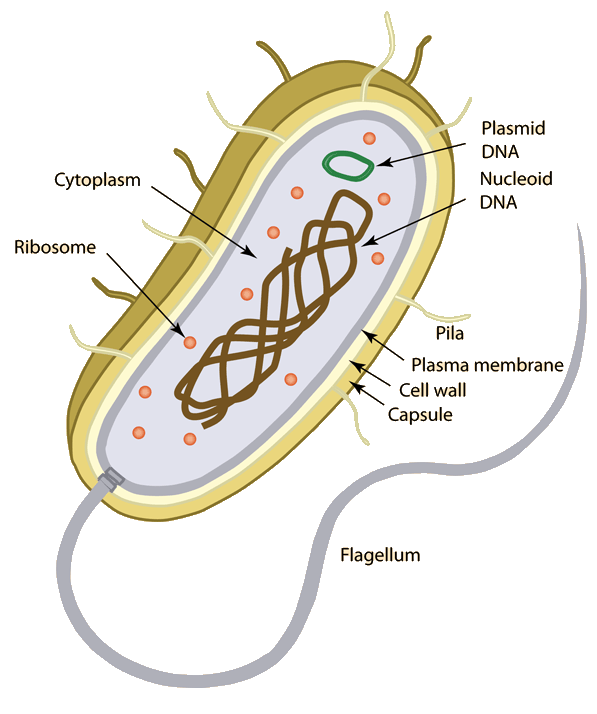
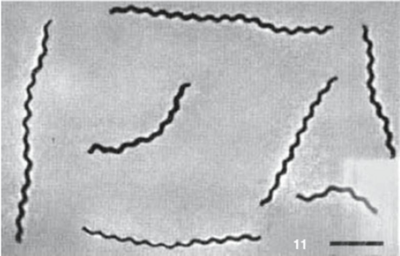
Due to these constraints, bacteria have developed interesting ways to move around. The most common of these methods is the use of flagella, which are whip-like appendages connected to the main cell body by a hook.


Conclusion
Given their microscopic size, it's quite fascinating to see such developed forms of movement. A naturally occurring rotating element and motor are certainly surprising characteristics to find in puny bacteria since these are things that cultured humans like Pichael need lots of brainpower and resources to create. Nevertheless, it makes sense, since these traits were the response to a completely different set of rules on the microscopic level.
Sources
I highly recommend reading Life at Low Reynolds Number for a more in depth look at this topic. This paper on bacterial hydrodynamics provides a closer look on bacteria mechanism for movement, especially the use of rotating flagella. Additionally, this post on hydrodynamics has great analogies and examples relevant to the Reynolds number.Peer review
For project 3 Leo composed an edutainment blog about the movement of bacteria and the challenges of moving anything at a microscopic level. He focuses on three main scientific topics, the Reynolds number, Microscopic movement and how bacteria overcome their difficult environment to move around. He begins with an explanation of the Reynolds number and how it is calculated and then discusses what happens to the Reynolds number at a microscopic level before focusing on the movement of bacteria.
This blog post is well thought out and fits well with the schema created by group 1. In particular, the visuals are very effective aides alongside the explanation of complex scientific and engineering concepts. The explanation of the Reynolds number was easy to understand and I believe that your intended audience will be able to grasp the concepts outlined in this blog post. All the required technical information is explained well, and the intended audience of the high school educated population will be able to comprehend it.
As mentioned in you writer's memo, I do believe you have yet to decide on what the main topic of this blog post should be. The title of the post is "How do bacteria move", but this is only addressed very briefly at the end of the post. This post could equally be about the principle of the Reynolds number in general, what happens to movement at a microscopic level or how bacteria overcome the challenges of their environment, specifically related to movement. I think you have all the content necessary to pursue any one of these three topics, the post would just need to be edited to use that information to focus on the answer to the main question. Of the three topics, I believe you will have the most success by focusing on movement at the microscopic level. The information about the Reynolds number would serve as a good lead in to the microscopic environment and the challenges it presents. In particular, the idea that no movement is possible at the Reynolds numbers seen at microscopic levels is theoretically impossible as it would be inherently reversible should be expanded upon. By establishing the conditions of movement at the microscopic level, you could then explain how nature has found ways to overcome these challenges(the scallops or flagella).
Overall, I believe this post is very well constructed and has a good balance of scientific information and the analogies and pictures that help explain the complex topics. The post adheres very well to the schema created by group one and is both educational and interesting to read. My main advice is to make minor changes throughout the piece that focuses the information towards answering one main question, rather than three at once.
Instructor Note
This post is a great example of the genre--an appropriate topic, tone, and level of complexity for a non-specialist (me) to easily understand. I also think your use of images was helpful throughout, and the extended Pichael Melps analogy worked well. Nice work.